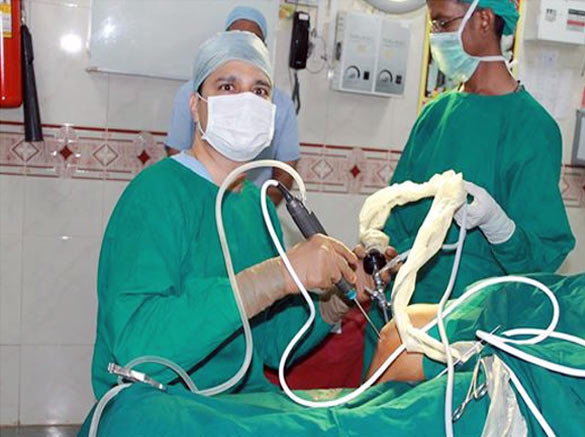
Arthroscopic Surgery
Arthroscopy (also called arthroscopic surgery) is a minimally invasive surgical procedure performed on a joint. It allows doctors to examine and sometimes treat damage using an arthroscope, a small endoscopic camera inserted into the joint through a tiny incision.
Arthroscopic procedures are commonly used to evaluate or treat several orthopaedic conditions such as torn cartilage (meniscus), damaged articular cartilage, ACL reconstruction and trimming of damaged joint cartilage.
Unlike traditional open surgery, the joint does not need to be completely opened. In knee arthroscopy, only two small incisions are required – one for the arthroscope and another for surgical instruments. This approach reduces recovery time, minimizes trauma to surrounding tissues and results in less scarring.
Arthroscopy is especially beneficial for athletes and active individuals who require faster healing. The surgeon views the joint on a video monitor and can accurately diagnose and repair damaged ligaments, cartilage and other joint tissues.
Arthroscopic examinations can be performed on several joints, most commonly the knee, shoulder, elbow, wrist, ankle, foot and hip.